


Criticism
Top 60 masters Roxana Werner
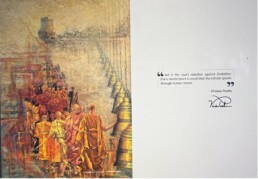
Where Time Lingers in Silence
What if decadence were not the end, but an opening?
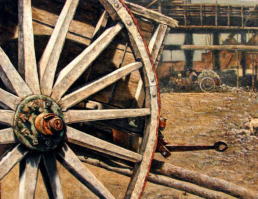
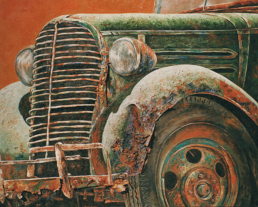
In Roxana Werner’s paintings, rusted vehicles, splintered wood and faded pigments become much more than relics of the past: they become sacred artifacts of lived experience. With a brush steeped in reverence, Werner does not lament what time has eroded. He listens to it.
Their textures are not illusions.
They are tactile memories, layered with earthy whispers and the rough patina of forgotten paths. He doesn’t invent stories; he excavates them. Each rivet and crevice speaks to the viewer with raw intimacy, drawing them into stories both personal and collective. Each piece carries the soul of its surroundings: the Chilean saltpeter towns, the shores of Valparaíso, the vivid contrasts between Morocco and India. These are not imagined worlds; they are worlds embodied, traversed, felt, and ultimately reimagined through Werner’s gaze.
A tireless traveler and seeker, Werner believes that art must be lived before it is created. His process is deeply immersive.
He wanders into arid deserts and tangled harbors, absorbing the aura of each environment before returning to the solitude of his studio. There, time drags on. The light thickens. And the stories begin to surface in brushstrokes that feel at once archaeological and poetic.
Throughout his extensive body of work, one story line emerges: the preservation of essence. Whether capturing the soul of a rusting ship or the serene dignity of a weathered face, Werner’s art honors the tension between impermanence and endurance. It is this paradox – fragility fused with power – that makes his paintings resonate so deeply.
Roxana Werner paints with devotion. Her art is not spectacle, it is writing. A visual testimony of what remains after the…
The noise has faded in the wake of modernity. And in that silence, the viewer is invited to pause, to witness and, perhaps, to remember something he did not know he had forgotten.
Roxana Werner Global Art Future Masterpiece Prize
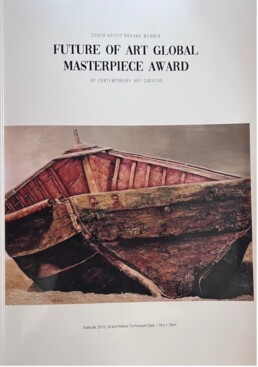
Roxana Werner’s “Chilote Truck,” a mesmerizing oil and mixed media painting on canvas from 2010, stands as a monumental achievement in contemporary art, deserving of its recent accolade, the Future of Global Art Masterpiece Award. This prestigious recognition, given to artists whose work profoundly impacts the global art scene, perfectly encapsulates Werner’s contributions to the art world through his distinctive creativity and unparalleled innovation.
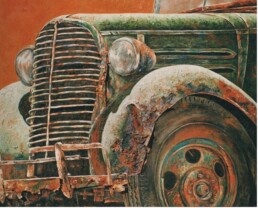
Nostalgia for today's world: Roxana Werner's ethnographic spaces.
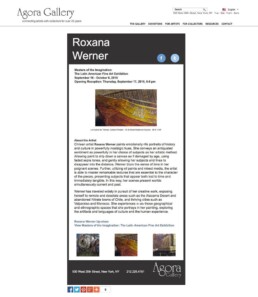
New York
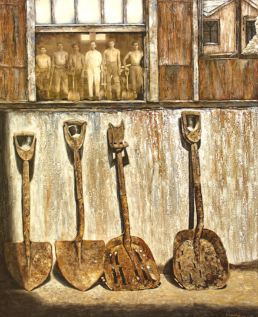
Chilean artist Roxana Werner paints emotive portraits of history and culture in deeply nostalgic tones. He conveys a sense of the antique with as much strength in his choice of subjects as in his artistic method. By letting the paint drip onto the canvas as if damaged by time, using faded sepia tones and letting his subjects and lines disappear delicately into the distance, Werner blurs the sense of time in his poignant scenes. In addition, using oils and mixed media, the artist manages to master extraordinary textures that are essential to the personality of the pieces, presenting themes that seem both lost in time and tangible. In this way, his scenes present worlds simultaneously present and past.
Werner has traveled extensively in search of his creative work, exposing himself to remote and desolate areas such as the Atacama Desert and the abandoned saltpeter towns of Chile, as well as cities in both Valparaiso and Morocco. He experiences in situ the geographical and ethnographic spaces he portrays in his paintings, exploring the artifacts and languages of culture and human experience.
Gallery location: 530 West 25th St, Chelsea, New York City
Volodia Teitelboim
National Literature Award
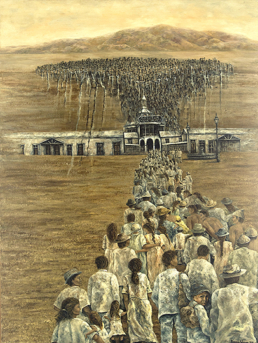
About the work of R. Werner; “Del Salitre a Iquique” Roxana’s work is huge. It comes from within. It combines light and shadow, pain and abandonment. It is solid and resistant to oblivion. It is beautiful. In Roxana, we salute a powerful, indestructible creator.
Maureen Berger H.
TELL Magazine
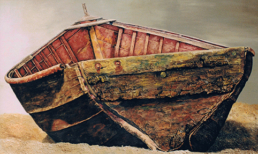
“Methodical, scientific but also emotional and visceral is Roxana Werner, painter, owner of such an energy that not only allows her to witness the abandonment of the objects and urban landscapes that she captures in her works, but also to keep latent and unquenchable the thirst to continue studying.
In the Valparaíso series, as in those of the North and South, it is impressive how she achieves that perfect balance, which on the one hand effectively shows a dark and depressing deterioration and on the other hand, makes that gate, boat, truck or city passage, something beautiful, of full light…
Carmen Silva
Visual Artist
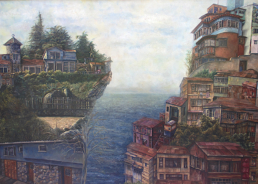
Roxana Werner’s paintings impressed me the first time I saw one of her exhibitions. Even more so now for many reasons: She, like others, dares to be a painter with a capital letter; Artist. She explores and demands herself rigorously in everything that is technique and craft. She composes with rhythm, with care. That could be catalogued as hyper-realistic. But no, because she adds dreams, imagination and poetry.
Added: It is linked to a very personal language, it takes the real, but adds a whole interior imagery. He reinvents the city. He gives his boats, jars, pots, jars, a striking effect, they have strength, effort, anger, pain, nostalgia.
Added: They will say, as they say, that it has “masculine” strength, a decision of stroke and composition, color … But no. It is tremendously feminine, it has that fine mixture of tenacity, strength, poetry, tenderness that this painter-woman has.
Recognizing that there is nothing more difficult than being a painter and being a woman painter, almost heroic. If not, let’s think of Frida Kahlo, Camile Claude, Berthe Morisot and who else? We applaud that already, with all that we know that it has cost her, it will cost her, we are talking about a PAINTER and we applaud, we rejoice to have the honor of writing about her.
Cristina Hederra
Gestión Cultural, Traveling Chile Magazine, Bilingual Edition, June 1998 "Panorama Cultural".
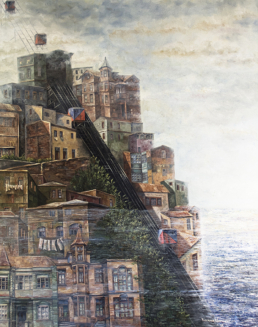
“Roxana Werner, landscape painter of the soul of a mythical port: Valparaíso. She works with oils, she is a sculptor of time. One of her merits is to bring a mythical vision of the port of Valparaíso, where she conjugates the dream with reality.”
Karen Medina Eguiluz
Journalist, Bachelor's Degree in Social Communication Coordination and Cultural Extension Universidad de Playa Ancha, Valparaíso
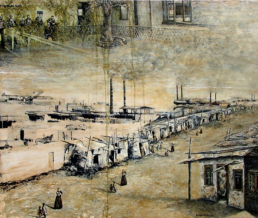
A commitment to Justice and Memory. Presenting the work of Roxana Werner is of special value. Her oil paintings and mixed techniques are the result of a work charged with the emotion that provokes the certainty of abandonment and neglect, and at the same time the commitment to the denunciation in favor of equality and justice. The works that make up “Del Salitre a Iquique” are the inspiration of those who know very well how to combine the beauty of art with critical awareness. In a silent way the artist recreates the environment with content, with heart, opening to others through a message where the value load is always present that calls us to remember that even this society has many pending issues.
Added: One hundred years after the Massacre of the Santa María School in Iquique, Werner pays homage to the saltpeter miners, their women, their children, their spaces. His brush denounces abuse and exploitation. His colors speak to us of the pain lived in the pampas in 1907; of tearing and cruelty, of injustice and death. His visit to Valparaíso (beginning his tour) is part of the itinerancy of the works that make up “Salitre a Iquique”. The National Council for Culture and the Arts and the Universidad de Playa Ancha join and coordinate this effort to invite the various communities to this space of encounter with the memory of the workers’ movement, reaffirming the citizen’s commitment to the message of justice and future hope.
Valentina Eytel Pastor
"Materia Prima Magazine"
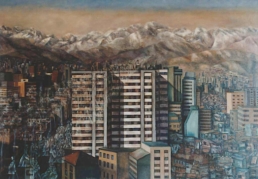
Urban Testimonials
“Roxana Werner’s works are true testimonies of our urban reality. When Valparaíso was a forgotten port, she rescued it for ten years by means of canvases and brushes. Now, she looks for the traces that time has left in the most diverse objects, scattered in the saltpeter works of the north or the islands of Chiloé”.
Jorge Salomo Flores
Professor of Art History and Aesthetic Appreciation
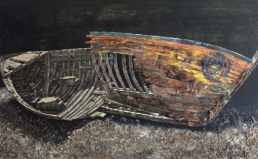
In Roxana’s canvases, objects come to life, they are linked to other materials, they reveal their textures, their materiality. Her painting could be described as expressionist. The urban realism that we find around us, often forgotten, palpitates in the canvases, as if it needed an artist to emerge again and regain vitality.
With Roxana Werner’s brushes, we feel we are walking in a southern cove, passing through an arid northern street, feeling the metallic texture of the old oil drums, now turned into garbage cans…in short, we can meet again with simple aspects of daily life, which make up that evocative world that each one carries in his memory. Then, we find “the trace of our own time”.
"Hidden Treasure Art Magazine" London-England
Curator and Editor HT Art Magazine Publishing Georgia Ellis
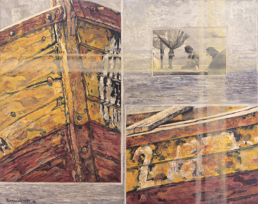
We were fortunate to come across your work in International Contemporary Artist Book, Volume VIII. We accessed your page and reviewed your work which is particularly interesting, being just the style we want to include in our publication of: “The Hidden Treasure Art Magazine, Yearbook 2015”.
www.ht-artmagazine.com
Artelista" Madrid-Spain
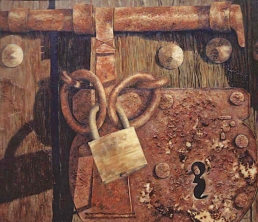
Critique: Whenever I see your magnificent work, I always admire the colorfulness and strength of those metals and woods beaten by time, as if they were shouting their existence before disappearing and not passing into oblivion. Congratulations to those hands that give life to your canvases and give us this magnificent Art.
I.C.A Publishing" New York-USA
Assistant Curator, Julia Adison
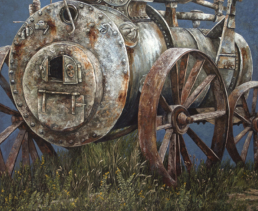
I.C.A. Publishing : Your work is really impressive and we’ll be honored to presented it in the book.
www.incoartists.com
Jonathan D. Fakinos
Curator / Director Zenith: Art
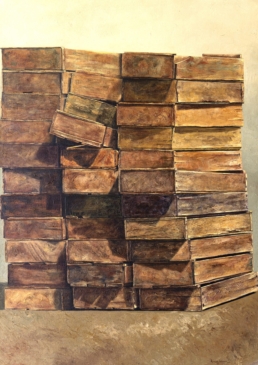
It is a pleasure to congratulate Roxana Werner for her impressive creations.
www.zenithartandfashion.com
"Contemporary Art Curator"
Stockholm-Sweden
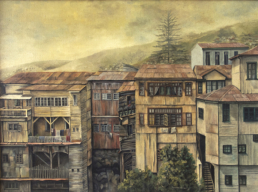
Roxana Werner is an artist specialized in realistic oil painting. Despite her extraordinarily technical approach, she is a highly personal and expressive artist. Her paintings contain a mixture of realism and dreamlike sequences that feel fantastic to assimilate.
www.contemporaryartcurator.com
"France Press"
Paris-France / Juan Angel Torti
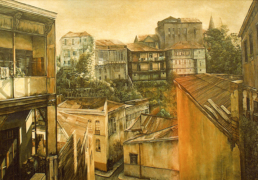
Roxana Werner came to the Montmartre Hills from Lisbon, her current residence, to exhibit 25 canvases depicting the hills, elevators, churches and nooks and crannies of the former Port of the South Pacific.
(Retrouvez Montmartre sur Internet : ww.parismontmartre.net)
Global Art Agency
The GAA curatorial team has seen your art and believes it would be interesting for our international art exhibition. Our audience would find it interesting and, therefore, we have decided to invite you to participate in THE MIAMI ART EXPO.
www.globalartagency.com
Art Management Berlin" Berlin-Germany
Gabriela Caranfil
Having found your artwork on your website, first I would like to congratulate you on your impressive artistic style.
Added: We really admire your work and therefore, secondly, I would like to invite you to participate in the exhibition “Colors of the Soul“.
www.galleria360.it
Venessa DiPardo
Researcher of international artists for Galleria 360 based in Florence, Italy.
Having found your artwork on your website, first I would like to congratulate you on your impressive artistic style.
Added: We really admire your work and therefore, secondly, I would like to invite you to participate in the exhibition “Colors of the Soul“.
www.galleria360.it
Art Management Berlin" Berlin-Germany
Gabriela Caranfil
Roxana Werner, we inform You that You’ve been selected by “Art Management Berlin “to be included in “The First Berliner Art Book – 2016 “and that for us it will be an honor to introduce You to become a part of it.
www.art-management-berlin .de
Artexpresión Gallery" Barcelona-Spain
Susana Weingast, Art Historian, Visual Artist, Curator, Writer
Exhibition: “Imágenes Internacional Latinas” Award for “Creativity”
Roxana, I congratulate you, your work is of high quality and style. Susana Weingast
www.artexpresion.com
Álvaro Donoso, Art Critic
La Estrella "Plastica" Valparaíso
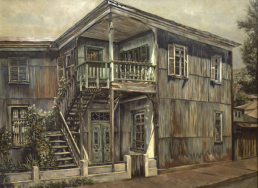
Artist Roxana Werner presents at the National Congress Hall of Honor
“Roxana uses a hyperrealistic treatment in her Valparaíso. No person passes through the fog. A cold and empty city where only the clothes hanging in the wind indicate that someone resides there. Valparaíso allows him everything. Poetry, magic, the distortion of perspective that the author applies to its houses and streets, the phantom funiculars that continue to rise through the clouds. This is the common denominator of the Valparaíso painted by Roxana Werner. A city always cloudy, where the fog penetrates the rooms, the souls of its invisible inhabitants. Never a blue sky. The artist’s palette is austere”.
Eugenio Rodriguez
El Mercurio de Valparaíso, September 1996.
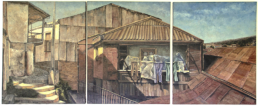
From Valparaiso to Instances with the Female Figure”.
Added: “In this exhibition, Roxana Werner seeks a thematic and technical balance that goes from academicist to creative freedom, both in the landscape and in the human figure. The exhibition is called: “From Valparaíso to Instances with the Female Silhouette”. This is because, in this eagerness to open up to other themes, this exhibition exhibits, as a complement to the landscapes, a series of female nudes closer to an academic conception in both form and substance.
THE HUMAN FIGURE: The artist has treated it in a very intense way, giving flight to her creative imagination in search of the nuances that differentiate her from the rest and give her canvases that personal seal that every artist longs for.
The two themes attract her equally, Valparaíso and the Human Figure, but in the human figure she incorporates a different approach, being her result closer to the avant-garde, more modern, which are born spontaneously on the canvas, but maintaining the academic ties in the stroke and drawing, not so in the stain.
In the landscape, the palette is looser, both in terms of color and drawing, with a thick paste that gives a different result, which denotes the artist’s concern for not falling into the anecdote of the landscape.
Roxana Werner’s concept of Valparaíso is transmitted through the use of sepia and grays.
His first exhibition was using the batik technique (Javanese art), in 1983, at the Ministry of Housing and Urbanism in the capital.
In painting, her initial exhibition was at the Cultural Center of Viña del Mar, in 1991. That same year she was chosen to participate in the collective exhibition in Europe, Holland: “Thirteen Chilean Artists”, at the Chilean Fair in Holland, inaugurated by President Patricio Alwyn Azocar.
Natalia Gryniuk
WOMAN'S ESSENCE SHOW 2019,EXHIBITION IN OFFICIAL PAVILLON OF 58 BIENNALE OF VENEZIA
PALAZZO ZENOBIO
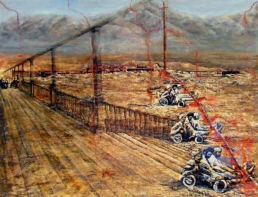
Excerpt from the Biennial Catalog about Roxana Werner
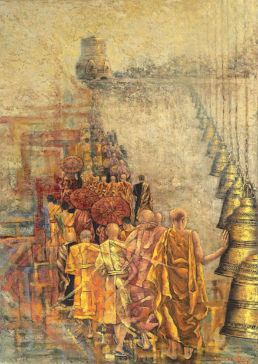
The spaces that motivate her to capture her works, are based on several reflections and sensations that lead her to question and discover the social aspects, history and the meanings they hide……… They are stories written through painting that investigates the concept of time, where the human condition related to the problems of ethics and justice is unveiled. Zen Buddhism is a living source of inspiration in his life and research. “More here and beyond the Border”, the last series he created, is permeated by this philosophy.